Chamber of Gods · The Decoded Series
CREATINE HCl
DECODED
Every honest answer about creatine hydrochloride — the chemistry, the 38× number, the dose the industry gets wrong, and what the research actually shows. No hype. Receipts included.
- 1A level 5.6 g scoop — the full creatine-equivalent dose
- 2Clear solution, no sediment, within seconds
Updated October 2026 · Written for people who read labels
Chapter I · Plate 1
What creatine HCl
actually is
Creatine hydrochloride is not a different ingredient to creatine. It is the same molecule wearing a different coat — creatine bonded to hydrochloric acid to form a salt.
Creatine itself is a small nitrogen compound your liver, kidneys and pancreas already build from three amino acids: glycine, arginine and methionine. You make roughly a gram a day. You eat roughly another gram a day if you eat meat or fish. Your muscles hold the rest in reserve.
Raw creatine is awkward to work with. It is poorly soluble, slightly alkaline, and in powder form it has a chalky mouthfeel that anyone who has drunk a gritty glass of monohydrate will recognise. So chemists do what pharmacists have done for a century: they make a salt. Attach hydrochloric acid to the guanidinium group of creatine and you get creatine hydrochloride — a crystalline powder that dissolves in water almost instantly and tastes sharply sour.
Here is the part most brands skip. The moment creatine HCl hits water, and certainly once it hits the acid bath of your stomach, that salt dissociates. The hydrochloride lets go. What crosses your intestinal wall and travels to your muscle is plain creatine, molecularly identical to the creatine from monohydrate, from a steak, or from your own liver.
The one-line version
Creatine HCl is a delivery decision, not a biological one. It changes how the powder behaves in your glass. It does not change the molecule that reaches your muscle.
That single fact is the key to reading every claim on this page — and every claim on a competitor's label. Anything that improves mixing, taste, scoop size or stomach comfort is a fair claim for HCl. Anything that claims a different or stronger effect per gram of creatine needs evidence, and we will look at exactly what that evidence says in Chapter V.
- 1Angular crystal habit — it catches light instead of clumping
- 2Free-flowing and dry — moisture is what turns any creatine into a brick
Chapter II · Plate 2
The engine creatine
actually powers
Creatine does not build muscle. It buys you time — about ten extra seconds of maximum effort, repeated set after set, for years. That is where the muscle comes from.
Every contraction you have ever made was paid for in ATP. Your muscle holds only two or three seconds of it at a time. For a one-rep max, a 40-metre sprint, the last two reps of a heavy set, your body cannot wait for oxygen and glucose — it needs ATP rebuilt instantly.
That job belongs to phosphocreatine. It sits in the muscle holding a phosphate group, and an enzyme called creatine kinase hands that phosphate to spent ADP to make fresh ATP. No oxygen. No delay. It is the fastest energy system in the human body, and it is the only one creatine touches.
- 1Muscle fibre bundle
- 2Myofibrils — where contraction spends ATP
- 3Phosphocreatine pool, dissolved in the cytosol
Creatine kinase — the enzyme that performs the hand-off in Fig. 2 — is one of the fastest enzymes in human biology. It can regenerate ATP in under a millisecond, which is why phosphocreatine, and not glucose or fat, is what carries you through the first ten seconds of anything maximal.
What is already in you
A 70 kg person carries roughly 120–140 g of creatine, about 95% of it in skeletal muscle, and roughly two-thirds of that stored as phosphocreatine. You turn over 1–2 g a day. Supplementing does one thing: it tops the tank from around 60–80% full to as close to 100% as your muscle will take.
This is also why the biggest responders are vegetarians and vegans — they start furthest from full. And why some lifelong meat-eaters feel almost nothing: they were nearly saturated to begin with.
Interactive · the food equivalent
Creatine is not a synthetic invention — it is in your food. It is just absurdly inefficient to eat enough of it.
Chapter III · Plate 5
The 38× number,
and what it really means
You have seen "38 times" on a tub. It comes from a real paper. It does not mean what the tub implies.
In 2010, Gufford and colleagues characterised six creatine salts in the Journal of Dietary Supplements. They measured aqueous solubility and partition coefficients and reported the hydrochloride to be approximately 38 times more soluble than creatine monohydrate [1]. That finding is solid and it is the honest foundation of the entire creatine HCl category.
What the paper measured was solubility — how much powder a given volume of water will hold. What a lot of marketing turned it into was "38× more bioavailable", or worse, "38× more potent, so you only need a fraction of the dose". A 2022 critical review in Nutrients singled out exactly this leap, noting that the claim goes well beyond what was actually measured [2].
Where the logic breaks
Creatine monohydrate is already absorbed at close to 100% bioavailability in humans. There is no absorption gap left for a more soluble salt to close. You cannot improve on nearly complete.
So solubility is not a potency multiplier. It is a formulation advantage, and a real one: a powder that vanishes into 150 ml of water instead of settling as sludge at the bottom of a glass is genuinely nicer to take, easier to dose in small volumes, and far easier to flavour — which matters more than the internet admits, because the supplement you actually take every day beats the one you abandon in a cupboard.
- 1Monohydrate — undissolved sediment
- 2Creatine HCl — fully in solution
Interactive · stir the glass
Equal weights of powder, 150 ml of cold water, same spoon. Drag to stir.
Monohydrate
Gritty
Creatine HCl
Clear
The chloride-transporter coincidence
A detail worth knowing, because you will eventually see it misused. Creatine enters muscle through a transporter called CreaT1 (SLC6A8), and that transporter is both sodium- and chloride-dependent. Creatine HCl happens to arrive with a chloride ion attached.
It is a genuinely neat coincidence. It is not evidence of better uptake. Chloride is one of the most abundant ions in your body and your extracellular fluid is not short of it. Nobody has shown that the chloride from a creatine salt changes transporter activity in a human being. We mention it because it is interesting, and we label it clearly because it is unproven.
Chapter IV · Plate 5
The dose the industry
gets wrong
If you remember one chapter from this encyclopedia, make it this one. It is the difference between a creatine HCl that works and a creatine HCl that is a very soluble placebo.
Because creatine HCl dissolves better, a generation of products decided it must also be stronger — and quietly cut the dose. You will find tubs offering 750 mg, 1 g or 2 g per serving, often with a line implying that this equals 5 g of monohydrate.
There is no evidence for that equivalence. None. The 38× figure was a solubility measurement [1], the "more bioavailable" extrapolation has been explicitly criticised [2], and the only serious head-to-head trials dose both forms at the same few grams per day [3].
What we do know with confidence is the amount of creatine — the molecule itself — that saturates a human muscle. That number comes from decades of monohydrate research: roughly 3–5 g of creatine monohydrate per day, or about 0.03 g/kg of bodyweight, for maintenance [4].
So the honest way to dose creatine HCl is to work backwards from the molecule. Monohydrate is 87.9% creatine by weight. Creatine HCl is 78.2%. That means a gram of HCl delivers slightly less creatine than a gram of monohydrate, so a correct HCl dose is about 12% larger, not 85% smaller.
The rule
Dose creatine HCl for the creatine, not for the salt. Everything below is just that one sentence, with arithmetic.
The equivalence engine
Enter your bodyweight. Get the dose that actually delivers saturating creatine — in both forms, with the maths shown.
—
The 750 mg problem
A 750 mg serving of creatine HCl delivers 0.59 g of creatine. Against the daily target the calculator just gave you, that is — of what your muscle needs. You would need — of those servings a day to reach saturation.
This is not a small rounding error. It is the difference between a supplement with forty years of evidence behind it and an expensive sour drink.
Why does anyone sell 750 mg? Creatine HCl costs several times more per kilogram than monohydrate. A tiny serving makes an expensive raw material look affordable, and the 38× claim provides the cover story. Now you can spot it in two seconds: divide the milligrams of creatine HCl by 1,280 and you have the grams of creatine you are actually buying.
- 15.6 g of creatine HCl — one level scoop, the full dose
- 2A 750 mg serving would be a dusting you could barely see
Keep the receipts coming
We publish one of these decoded breakdowns every few weeks — ingredient by ingredient, with the citations and the parts the industry would rather skip. No sales spam.
Chapter V · Plate 6
HCl versus monohydrate,
settled honestly
Monohydrate is the most studied sports supplement in human history. Creatine HCl is a better-behaved powder. Both statements are true, and neither one wins the argument on its own.
Around 95% of the creatine trials ever published used monohydrate. That is not a conspiracy — it is because monohydrate is cheap, stable and works, so researchers kept using it. It also means any newer form starts the argument with a forty-year evidence deficit it cannot buy its way out of.
| What you are comparing | Creatine HCl | Monohydrate | Verdict |
|---|---|---|---|
| Creatine per gram of powder | 78.2% | 87.9% | Mono |
| Solubility in water | ≈38× higher [1] | Low — settles and feels gritty | HCl |
| Bioavailability | Near complete | Near complete | Tie |
| Strength & power results | No significant difference vs mono at 5 g/day over 8 weeks [3] | Gold standard, replicated for decades | Tie on effect, Mono on proof |
| Lean mass | Gained fat-free mass in trial; did not improve FFM index [3] | Gained fat-free mass and FFM index [3] | Mono |
| Volume per dose | Dissolves fully in 100–150 ml | Wants 250–300 ml to behave | HCl |
| Taste | Sharply sour, flavours beautifully | Neutral-chalky, flavours poorly | HCl |
| Stomach comfort | Widely reported as gentler; no controlled trial proves it | Can cause bloating or loose stools at 20 g loading doses | HCl, anecdotally |
| Research volume | A handful of small trials | Hundreds of trials, decades of safety data | Mono |
| Cost per gram of creatine | Several times higher | The cheapest effective supplement on earth | Mono |
The trial that matters most
Londoño-Velásquez et al., Journal of the International Society of Sports Nutrition, 2025 [3]
- 31 elite handball and softball athletes, aged 18–28
- Triple-blind, placebo-controlled, three arms: monohydrate, HCl, maltodextrin
- 5 g per day of each form, 8 weeks, DXA body composition and isokinetic strength
- Result: no statistically significant differences between groups on any measure
- Both creatine groups improved jump performance and fat-free mass; only monohydrate improved the fat-free mass index
The authors' own words: claims of creatine HCl superiority are "unfounded and misleading". We are a brand that sells creatine HCl, and we are printing that sentence on our own page, because you deserve to decide with it rather than without it.
So why does COG use HCl?
Not because it is stronger. Because of three things that decide whether a tub gets finished:
- It disappears into water. No sludge, no chalk, no scraping the bottom of a shaker.
- It tastes like something you want. A sour base is a flavourist's dream. Monohydrate fights every flavour you put on it.
- It is kinder in small volumes. 150 ml, one go, no 20 g loading bloat if you choose not to load.
And one condition: we dose it at full creatine equivalence, print the creatine-yield on the label, and never claim a gram of our HCl beats a gram of anyone's monohydrate. If you want maximum evidence per rupee, buy good monohydrate — we will tell you that to your face. If you want the best-drinking creatine you will actually take daily, that is what we built.
Chapter VI · Plate 7
How to take it
Creatine is the least fussy supplement in your cupboard. Almost everything people argue about makes no measurable difference. Three things do.
1 · The dose, every day
Saturation is a function of total creatine taken over time, not of any single serving. Hit your creatine-equivalent target daily — including rest days, which is where most people quietly fail. Muscle creatine does not care that it is Sunday.
2 · Timing barely matters
Pre-workout, post-workout, with breakfast, before bed — the differences in the literature are small and inconsistent. If there is a marginal edge it leans slightly post-workout, taken with a meal containing carbohydrate and protein, because the insulin response gives creatine transport a modest push. Treat that as a bonus, not a rule. The best time is the time you will not forget.
3 · Drink it fresh
This one is specific to acidic forms and almost nobody mentions it. Creatine in solution slowly converts to creatinine, an inert by-product, and that conversion runs faster in acidic and warm conditions. Creatine HCl makes an acidic solution by design. So mix it and drink it within about fifteen minutes. Do not leave it in a bottle in a hot car, and do not pre-mix tomorrow's dose tonight. In dry powder form it is perfectly stable — this is a glass-of-water problem, not a tub problem.
Loading versus just starting
Both routes arrive at the same place. One is faster, one is gentler on your stomach.
Water
Creatine pulls water into the muscle cell, so your fluid needs rise slightly. Drink normally and to thirst. The old warning that creatine causes dehydration or cramping has not held up — if anything the evidence leans mildly protective in the heat.
Caffeine
A single 1996 study hinted that high-dose caffeine blunted creatine's benefit. It has never been convincingly replicated, and millions of people take both in the same pre-workout. Do not lose sleep over your coffee.
Cycling
Unnecessary. Your body does not downregulate its own creatine synthesis permanently, and there is no receptor to desensitise. Stop taking it and stores simply drift back to baseline over four to six weeks.
Chapter VII · Plate 8
What actually happens,
week by week
Honest expectations, in order. Nothing here is a promise — individual response varies enormously, and roughly one in five people are near-saturated already and will notice very little.
Days 1–7
Filling up
Stores climb. Scale weight may rise 0.5–2 kg — this is water drawn inside the muscle cell, not fat and not bloat under the skin. Some people feel fuller arms and legs. Most feel nothing yet.
Weeks 2–4
The extra rep
Saturation completes. The classic signal appears: one or two more reps at the same load, better quality on the fourth and fifth set, faster recovery between sprints. Small, repeatable, compounding.
Weeks 4–12
Real adaptation
Those extra reps become training volume, and volume becomes tissue. Trained lifters in controlled trials typically out-gain placebo by a meaningful margin in strength and lean mass over this window.
Month 3 onward
Just infrastructure
Nothing dramatic — a full tank stays full. Creatine becomes background infrastructure like protein intake or sleep. Long-term use in healthy adults has one of the cleanest safety records in supplementation [4].
If you feel nothing
Three likely reasons, in order of probability: you are under-dosing (re-read Chapter IV), you are inconsistent on rest days, or you eat a lot of red meat and fish and were already close to saturated. Non-response is a real and documented phenomenon — it is not a sign of a bad product.
Chapter VIII · Plate 9
Beyond the gym
Muscle is not the only tissue that runs on ATP. The most interesting creatine research of the last decade has very little to do with lifting.
Your brain is metabolically expensive and it holds its own creatine pool. That has made creatine one of the more actively studied compounds in cognitive research, and the honest summary is: promising, early, and not settled. We will not oversell it.
The brain · emerging
The most consistent cognitive findings appear when the brain is under stress — sleep deprivation, mental fatigue, high cognitive load — rather than in rested, well-fed young adults, where results are mixed. Doses used in brain research are often higher than muscle doses, and run longer. Treat any "creatine makes you smarter" headline with suspicion.
Vegetarians & vegans · strong signal
Dietary creatine comes almost exclusively from meat and fish. Vegetarians start with lower muscle and brain creatine, and they show the largest responses in both strength and cognitive studies. If you eat no animal products, creatine is arguably the single highest-value supplement available to you — more so than any protein powder.
Women · under-studied, promising
Women have been historically under-represented in creatine research, which is finally changing. There is no evidence that creatine causes unwanted weight gain, bloating or "bulk" in women; the intracellular water effect is the same modest, muscle-bound phenomenon it is in men. If you are pregnant or breastfeeding, talk to your doctor first — the research simply is not there yet.
Ageing · active research
Combined with resistance training, creatine has been studied for its role in maintaining muscle mass and strength in older adults. Training is the active ingredient; creatine appears to help the training work better. It is not a substitute for lifting.
Nothing in this chapter is intended to diagnose, treat, cure or prevent any disease, and none of it is medical advice. Where the research is early, we have said so in the heading rather than the small print.
Chapter IX · Plate 10
Eleven myths,
dismantled
Tap any claim to open it. We have marked each one true, false or genuinely unsettled — including the ones where "unsettled" is inconvenient for us.
Chapter X · Plate 11
How to read a
creatine HCl label
Seven things to check, in thirty seconds, on any tub in any shop. Tap a number on the label.
- 1Front of pack: the form has to be named here, not hidden in a blend
- 2Side panel: go straight to the creatine yield line
- 3Lower panel: batch code and a certificate you can actually open
The kitchen test
Real creatine HCl behaves unmistakably. Drop a gram into 100 ml of cold water: it should vanish within seconds with no cloud and no sediment, and the water should taste sharply sour. If your "HCl" is chalky, cloudy, slow to dissolve or tastes neutral, you are very likely drinking monohydrate at an HCl price. It is a thirty-second test and it is remarkably revealing.
Chapter XI · Plate 12
Why it tastes sour,
and why that is a gift
Monohydrate tastes like wet chalk because it is nearly insoluble and slightly alkaline. Creatine HCl tastes sour because it is an acid salt. One of those is a flavour problem. The other is a flavour opportunity.
When creatine HCl dissolves it releases hydrogen ions and drops the pH of the solution into roughly the 2 to 3 range at concentration — comparable territory to lemon juice. Your tongue reads that as sour and astringent, with a faint saline edge from the chloride.
For a formulator this is excellent news, because sourness is the one taste that almost every great beverage is built on. You cannot make monohydrate taste like a cold drink — the chalk fights you. With HCl you are starting from the same place as a lemonade, a sherbet, or a kala khatta gola.
What pairs with acid
- Citrus and tropical — lemon, lime, mosambi, pineapple, mango, passion fruit. The acid reads as freshness rather than as a flaw.
- Sour berry — blue raspberry, cranberry, jamun, black grape. Sourness amplifies the perception of fruit intensity.
- Indian khatta-meetha — aam panna, jaljeera, nimbu soda, imli, kala khatta. These flavour systems are designed around acid, salt and spice, which is exactly the palette creatine HCl hands you.
- Cooling counterpoints — mint, cucumber, watermelon, rose. Acid plus cool is the most refreshing axis in beverage design.
- What does not work — chocolate, vanilla, coffee, cream, anything dairy-adjacent. Acid curdles the idea before it curdles the milk.
- 1Citrus — the natural partner to a low pH
- 2Raw mango and black salt — the khatta-meetha axis
- 3Mint and melon — the cooling counterpoint
A formulator's note
Because the base is already acidic, a well-made creatine HCl needs far less added acidulant than a typical powdered drink — which leaves more room for the actual fruit character and keeps the sweetener load low. The sourness is not something to mask. It is the foundation to build on.
Which brings us to the one chapter of this encyclopedia that is not written yet.
The unwritten chapter
You decide what
we make next
We have the chemistry sorted. What we do not have is your palate. Two questions — one on flavour, one on format. The winners go into development, and we publish the vote count when we announce them.
Why are there no percentages showing yet? Because we refuse to print numbers we have not counted. The tally goes live on this page the day the ballot closes — the same way we handle every other number in this encyclopedia.
Chapter XII · Final plate
What nobody knows yet
An encyclopedia that only contains answers is a brochure. Here is the honest edge of the map for creatine hydrochloride.
- Is HCl genuinely gentler on the stomach? Thousands of people say yes. No controlled trial has measured it head to head. This is the most commercially important unanswered question in the category, and it would be easy to study.
- Does the chloride ion do anything at the transporter? CreaT1 is chloride-dependent, HCl delivers chloride, and nobody has tested whether that matters in a human. Almost certainly not, but "almost certainly" is not data.
- Is there a dose below 3 g of creatine that still saturates over a longer period? Low-dose, long-duration protocols are under-studied, and the answer would reshape how every form is dosed.
- How fast does creatine HCl degrade in a flavoured, acidic, ready-to-drink format? Dry powder is stable. Bottled liquid is a real formulation problem that the industry tends to wave away.
- Does any salt form offer an advantage in brain creatine uptake? Brain uptake is slower and more limited than muscle uptake. Whether the delivery form matters there is genuinely open.
Our standing offer
If a study lands that contradicts anything on this page, we will change the page and date the change. This is Volume I. It is supposed to be revised.
Appendix A
Everything else
you asked
How much creatine HCl should I take per day?
Enough to deliver 3–5 g of creatine, which means roughly 3.4–5.6 g of creatine HCl for most adults. Creatine HCl is 78.2% creatine by weight, so you need slightly more of it than monohydrate, not less. Use the calculator in Chapter IV for your bodyweight.
Is 750 mg of creatine HCl enough?
No. 750 mg of creatine HCl delivers about 0.59 g of creatine — around an eighth of a 5 g monohydrate-equivalent dose. The idea that a small HCl dose equals a full monohydrate dose comes from a misreading of a solubility study, not from any trial.
Is creatine HCl better than creatine monohydrate?
Not for performance. In the best head-to-head trial to date — triple-blind, placebo-controlled, 5 g/day for 8 weeks in elite athletes — there were no significant differences between the two forms, and only monohydrate improved the fat-free mass index. Creatine HCl's real advantages are solubility, taste, smaller mixing volume and convenience.
Do I need to do a loading phase?
No. Loading (around 0.3 g/kg/day split into four doses for 5–7 days) saturates your muscles faster, but a standard daily dose reaches the identical end point in three to four weeks. Loading is a speed choice and is the main cause of creatine-related stomach complaints.
When should I take it — before or after training?
It barely matters. Total daily intake and consistency are what drive saturation. If you want the marginal edge, take it after training with a meal containing carbohydrate and protein. The single most important rule is to take it on rest days too.
Can I mix it in advance or leave it in a bottle?
Mix and drink within about fifteen minutes. Creatine in solution slowly converts to creatinine, and that conversion is faster in acidic and warm conditions — which an HCl solution is by design. The dry powder in a sealed tub is perfectly stable for its full shelf life.
Does creatine HCl cause bloating or water retention?
Creatine draws water into the muscle cell, which is the mechanism, not a side effect — expect 0.5–2 kg of scale weight in the first week. Subcutaneous "puffiness" is mostly a myth of the 20 g loading era. Many people find HCl more comfortable; no controlled trial has confirmed it, so we will not claim it as fact.
Is creatine safe for your kidneys?
In healthy people, the evidence base is reassuring, including long-term use reviewed in the ISSN position stand. Creatine does raise serum creatinine, which can look alarming on a blood test — tell your doctor you supplement. If you have existing kidney disease, speak to a doctor before starting.
Will creatine make me lose my hair?
There is no good evidence that it does. The concern rests on one small 2009 study that measured a hormone ratio, not hair loss, and has never been replicated.
Can women take creatine HCl?
Yes, at the same creatine-equivalent dose. There is no evidence of sex-specific risks, and the research in women is expanding quickly. If you are pregnant or breastfeeding, check with your doctor first — the data is thin.
Is creatine safe for teenagers?
Creatine has been studied in adolescent athletes with a good safety profile, but we recommend anyone under 18 involve a parent and a doctor or sports dietitian in that decision, and prioritise food, sleep and coaching first.
Does caffeine cancel out creatine?
Almost certainly not. A single 1996 study suggested high-dose caffeine blunted creatine loading; it has not been reliably replicated. Coffee and creatine coexist happily.
Can I take creatine HCl on an empty stomach?
Yes. Because it is acidic and fully dissolved, most people tolerate it fine on an empty stomach in a small volume of water. If you feel any discomfort, take it with food — the absorption difference is negligible.
Will I lose my gains if I stop?
Stores drift back to baseline over roughly four to six weeks, and you lose the intracellular water along with the small performance edge. The muscle you built by training through those months is yours to keep if you keep training.
Does creatine HCl need to be refrigerated?
No. Keep the tub sealed, dry and below about 25°C, away from humidity — moisture is the real enemy of any creatine powder, and it is also what turns a free-flowing powder into a brick.
How do I know my creatine HCl is real?
Three checks: the label should name the form and declare the creatine yield in milligrams, there should be a batch number with an available certificate of analysis, and the powder should dissolve in cold water within seconds and taste sharply sour. Chalky and neutral-tasting is a red flag.
Is creatine a steroid or banned in sport?
Neither. It is a non-hormonal compound found in meat and fish and synthesised in your own body, and it is not on the WADA prohibited list.
Can I take creatine HCl with protein, pre-workout or other supplements?
Yes. It stacks cleanly with protein, electrolytes, beta-alanine, citrulline and caffeine. The only thing worth avoiding is leaving it dissolved in liquid for hours before drinking it.
The Decoded Dispatch
One ingredient, fully decoded, every few weeks
No discount spam, no "last chance" countdowns. Just the next volume of this encyclopedia, the studies we read to write it, and first access when a ballot winner goes into production.
- New decoded volumes before they go public
- The vote results, with real counts
- Early access to new flavours and formats
- Leave whenever you like, one click
The product behind this page
Creatine HCl,
and nothing else
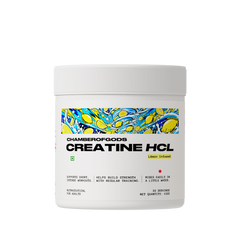
One ingredient. No fillers, no proprietary blend, no hidden yield. We print how much creatine a serving actually delivers, so you can run the arithmetic from Chapter IV yourself — on our pack, or on anyone else's.
See the productChamber of Gods · Built to exist for 100 years
Appendix B · Sources
What we read to write this
- [1] Gufford BT, et al. Physicochemical Characterization of Creatine N-Methylguanidinium Salts. Journal of Dietary Supplements. 2010;7(3):240–252. doi:10.3109/19390211.2010.491507 — the origin of the 38× solubility figure.
- [2] Bioavailability, Efficacy, Safety, and Regulatory Status of Creatine and Related Compounds: A Critical Review. Nutrients. 2022;14(5):1035. mdpi.com — on the leap from solubility to "bioavailability".
- [3] Londoño-Velásquez D, Zuluaga-Narváez Y, Rojas-Posada L, et al. Creatine monohydrate versus creatine hydrochloride on strength and body composition in elite team-sport athletes: a placebo-controlled randomized clinical trial comparing low dosages. Journal of the International Society of Sports Nutrition. 2025;22(Suppl 1):2533658. pmc.ncbi.nlm.nih.gov
- [4] Kreider RB, et al. International Society of Sports Nutrition position stand: safety and efficacy of creatine supplementation in exercise, sport, and medicine. JISSN. 2017;14:18. — dosing, loading and long-term safety.
- [5] Trial registration for reference [3]: ClinicalTrials.gov NCT05697900.
- [6] Systematic review of studies published 2009–2020 comparing creatine hydrochloride with creatine monohydrate — found insufficient evidence of superior strength outcomes for the hydrochloride, with a trend in its favour on solubility.
- [7] Creatine oral supplementation using creatine hydrochloride salt — US patent family assigned to Vireo Systems (e.g. US 8,354,450; US 8,962,685), the origin of the commercial form.
- [8] Vandenberghe K, et al. Caffeine counteracts the ergogenic action of muscle creatine loading. Journal of Applied Physiology. 1996;80(2):452–457. — the single source of the caffeine myth.
- [9] van der Merwe J, Brooks NE, Myburgh KH. Three weeks of creatine monohydrate supplementation affects dihydrotestosterone to testosterone ratio in college-aged rugby players. Clinical Journal of Sport Medicine. 2009;19(5):399–404. — the unreplicated study behind the hair-loss myth.
On our bias. Chamber of Gods sells creatine. We have cited every claim that favours us and labelled every claim that is unproven, including the ones we would prefer were settled. Last revised October 2026. Found an error? Write to us and we will correct this plate and date the change.